





Medium of Instruction (MOI) is an established and accepted admissions route, and for good reason. It simply makes sense for students who’ve completed previous schoolwork in English to be able to bypass traditional placement testing and prove their competency based on experience. With an MOI certificate in hand, they can apply for study abroad without the stress and inconvenience of placement testing.
The use of MOI has been on the rise in international student recruitment in recent years thanks to its ability to improve access and speed up admissions decisions. At a time when international admissions are continuing to scale up, it offers welcome flexibility – but it also creates a blind spot. Because MOI isn’t a standard measure of academic English ability, relying on it too heavily could increase the risk of students struggling with linguistic skills that aren’t sufficient for the course they’re embarking on.
So, what issues are universities up against, and what’s the solution? Let’s start with the bigger picture.
MOI for UK University Admissions: The background
International recruitment has expanded fast, with the House of Commons Library noting that the UK met the Government’s 2030 target for 600,000 international students ten years early.
At the same time, the English proficiency testing landscape is increasingly complex, and admissions teams no longer simply choose between IELTS vs TOEFL. A much wider set of tests, online formats and waiver routes now exist, each with different validity concerns and operational trade-offs.
A 2025 UK-focused study in ELT Journal highlights the complexity of English language test choices in UK higher education admissions, noting its implications for institutional practices, student success and differing stakeholder perceptions. It found that while 64% of institutions widened their accepted tests during the pandemic, 54% have since tightened their requirements owing to concerns over the reliability of newer, often at-home, tests compared to established ones like IELTS.
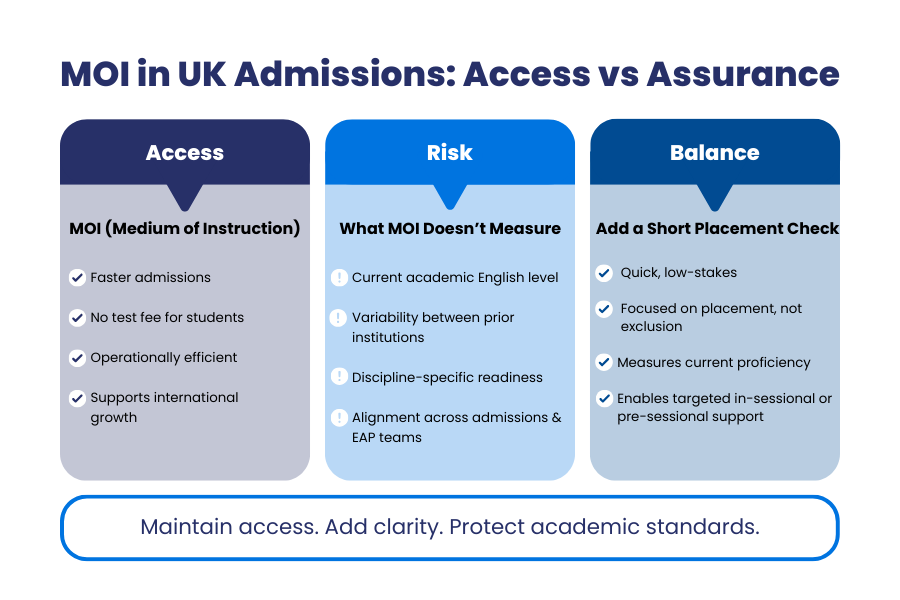
That’s where MOI – often described as an English test waiver route – is often seen as an attractive solution where relevant. It’s:
- Quick to process – it’s a simple letter or certificate
- Cheaper for applicants – there’s no test fee for them to factor in
- Simpler to handle during peak admissions cycles
Institutions may apply their own stipulations as to what they’ll accept. For Oxford’s graduate admissions, for instance, applicants must have completed degree-level study with conditions including being full-time, of sufficient duration and recent, and taught and assessed exclusively in English.
The challenges with relying on MOI
So far, so reasonable. But there are a few pitfalls – operationally and with academic alignment – that present potential challenges to universities.
First and foremost, MOI covers a wide range of educational contexts, meaning that two students who both have an MOI certificate could in fact have very different levels of readiness for various aspects of their course (academic reading and writing load, ability to participate in seminars, discipline-specific vocabulary and so on). It’s also conceivable that different teams (admissions, EAP, registry) may interpret MOI differently, leading to a mismatch in expectations.
The repercussions of this could mean heavier workloads for teaching faculty, who need to spend extra time supporting students whose English isn’t up to scratch. Indeed, The British Council has reported that many UK universities tightened English test requirements amid concerns over students’ academic struggles and strain on support services.
Related UK research on pre-sessional pathways also notes how institutions have expanded English preparation routes as part of their international recruitment strategies – an acknowledgement that language readiness at entry is variable, and needs managing rather than assuming.
Consistency at scale
It’s understandable, then, that as cohorts grow, institutions want a clearer picture of students’ current readiness while maintaining the access benefits of MOI. Some universities are adding in short placement checks for MOI cohorts – not full traditional testing, but quick, simple and low-cost checks that focus on placement rather than exclusion. The aim is not to deny any student a place, but to ensure placement decisions are informed by clear, measurable evidence. This enables the right academic support to be in place from the very first term, aligned to both their language proficiency and chosen subject.
Such placement checks add value in a number of different ways, providing better routing into direct entry, in-sessional support and short pre-sessionals. They lead to improved student experience and progression, as well as reducing the burden on teaching faculty. What’s more, placement checks measure the student’s current rather than historical English abilities, giving universities the confidence that their skills are up to date.
Mitigation and Solution: Adaptive Placement Testing
Adaptive testing is particularly suited to these quick checks, providing institutions with reassurance over students’ current language abilities while entailing less stress for the student than traditional placement testing. These work by adjusting the question difficulty in real time based on whether students answer correctly or struggle. This converges quickly on the student’s English level and avoids wasting their time on questions that are too hard or too easy. And because they can be taken online, they’re low-cost and accessible – a win for everyone.
We understand MOI isn’t for everyone but for those that are going down this route, our Oxford ELLT Spotlight English placement test is designed to give your institution a quick and easy way to double-check students’ proficiency level, strengthening assurance within MOI in UK university admissions. If you’d like to learn about how we can support you, get in touch to discuss placement solutions.