




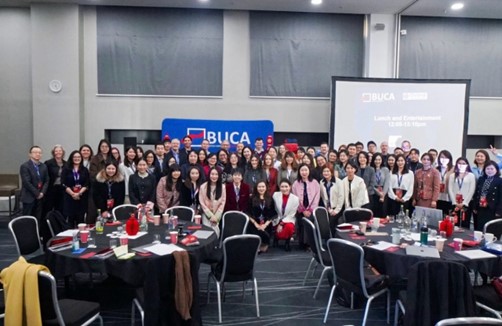
We were grateful to the British Universities’ China Association (BUCA) for hosting a timely and data-rich networking event in Manchester last week on Tuesday 3rd March 2026, with Oxford International Education Group (OID) as headline sponsor. The discussions offered a clear picture of where the UK–China higher education relationship currently stands — and where it is heading.

China Remains a Key Market
Felicity Lloyd, International Partnerships Manager at UCAS shared ECD data showing that China continues to be the largest enrolment market for the UK, with India in second place among international cohorts. Despite persistent headlines suggesting a decline, the reality is far more nuanced.
Dave Amor, Director at Higher Insights Ltd. highlighted that while the “big four” institutions have experienced decreases in recruitment from China, the wider UK sector has seen marginal growth. The market is shifting, but it is certainly not disappearing.
From a visa perspective, China remains incredibly low risk in terms of refusals. That said, visa success data revealed a decline in in-person Pre-Sessional English (PSE), with a stronger uptake in online PSE. This aligns with trends we have seen at OIDI, where demand for our online PSE provision is growing each year, particularly among students from China and Southeast Asia. At the undergraduate pathway level, demand has softened, reflecting changing student preferences and behaviours rather than a simple drop-off.
Online Delivery and Conversion are Key
James Perrin, Director of Global Sales at OIDI underscored a critical point: Online PSE demand is on the rise, and in international recruitment, “conversion is king.” Universities that modernise how they recognise and welcome varied pathway routes and delivery modes will be best positioned to compete.
TNE Partnerships: A Growing Opportunity
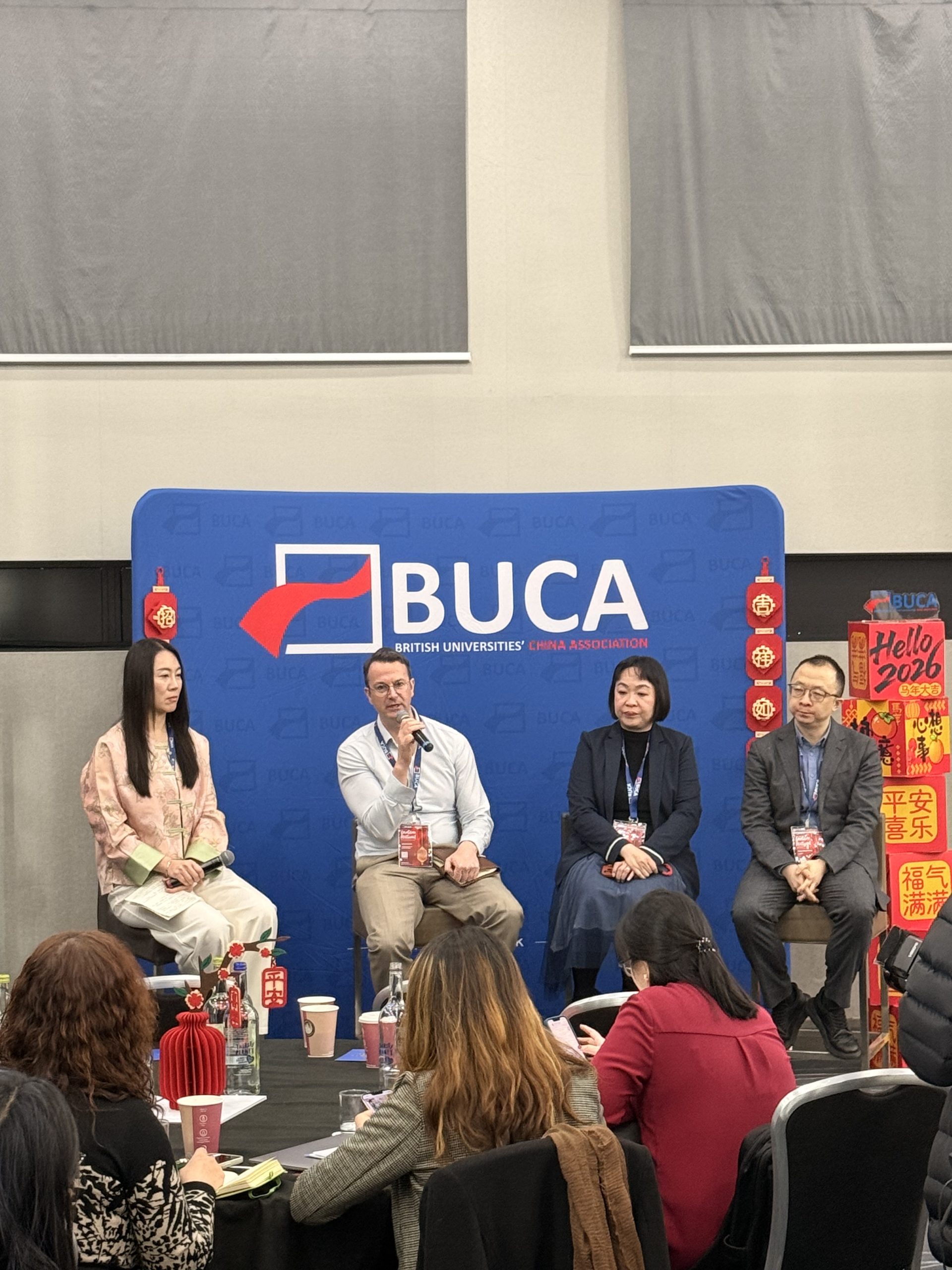
One of the most compelling insights came from Dr Cheryl Yu of the TNE Institute, who shared that China recorded its highest number of new TNE partnerships in over a decade in 2025 — 285 in total, with the UK holding 15% of that share. This demonstrates that transnational education (TNE) is central to the future of UK–China relationships.
Picture: Dr Cheryl Yu, Director of Programmes at TNE Institute
Embracing Alternative Routes
David Brown, Co-founder of OIEG, delivered the event’s closing remarks with an important reminder: don’t be frightened of alternative recruitment routes. Quality, accessibility, and long-term opportunities are increasingly more important than purely financial drivers.
David also emphasised the importance of mobility, urging universities to broaden its definition. Physical mobility remains vital, but blended models, collaborative online learning, and flexible delivery structures can support outbound and reciprocal engagement in equal measure. Sustainable partnerships require a two-way flow of students and knowledge, not just inbound recruitment.
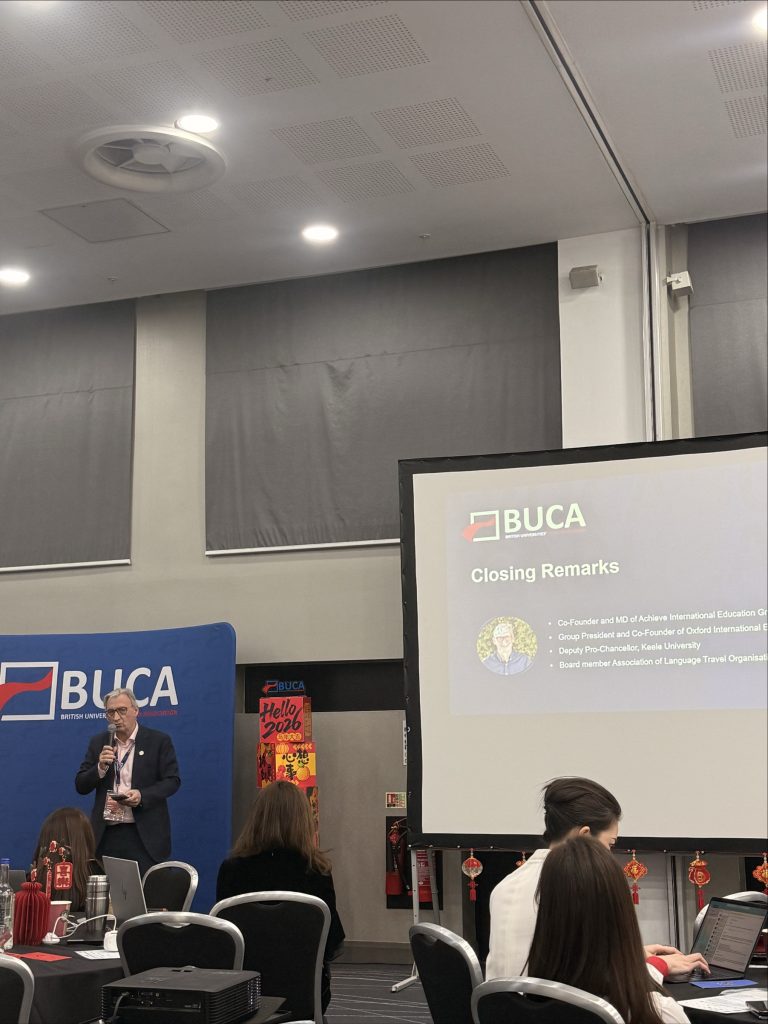
Picture: David Brown, Co-Founder of OIEG delivering closing remarks.
Turning Challenges into Opportunities
The overarching theme of the afternoon was clear: turn challenges into opportunity. The UK–China education corridor is evolving, not retreating. Those willing to adapt to new models, embrace alternative routes, and think beyond traditional recruitment metrics will find the greatest benefit.
Many thanks again to the BUCA team for hosting such an insightful and forward-looking event.
If you want to discuss these insights, or how we can strengthen our partnership – Get in touch!